Happy Holidays Everyone! A new video is up on how to make the SOFT and DELICIOUS Achuete Pork Floss Buns. I was inspired by BreadTalk, a boutique bakery in the Philippines that makes an array of sweet & savory pastries and baked goods. Pork floss buns from there are total bliss, and I wanted to recreate a recipe, so I can take a guilty pleasure back home! It is nearing a new year so it’s a great time to try something different, and won’t disappoint!
Following your own path.
Be who you are and say what you feel, because those who mind don’t matter and those who matter don’t mind. – Bernard Baruch
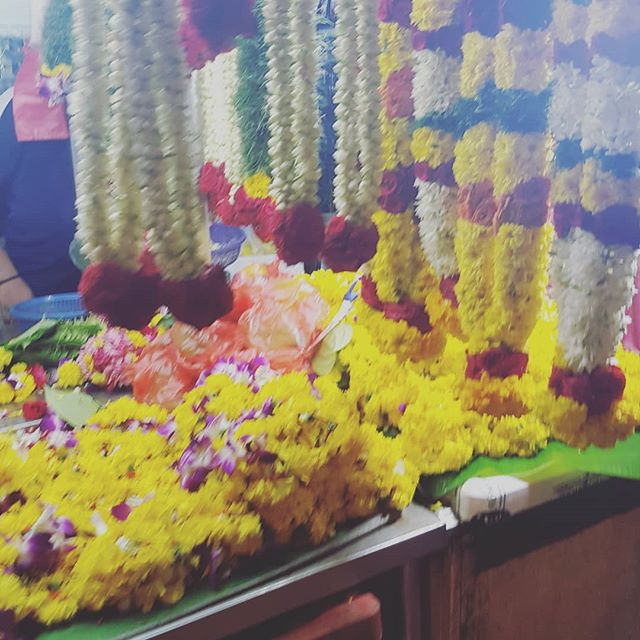
Traveling has given me insight on life and the assurance that there is more to life, and more to learn. Throughout my culinary career, I have had the opportunity to work in the States and abroad with an array of chefs, cooks and mentors that has shaped the cook that I am today. I have a hard time calling myself a chef, because in absolution I believe that is only respectively given to an individual that is the head (boss woman/boss man) of a professional kitchen. All in all, whether it be a chef or cooking in a professional kitchen, we are cooks. Disregard the ego, it’s about the craft, because in actuality it’s the fervor for cooking and the delight in sharing and bringing people together through it.
There are somewhat skewed misconceptions about cooking for a living and being in the industry. Expectations will not always meet reality. As a young cook, coming straight out of culinary school, I believed that the restaurant industry would be about the same as what I had learned from school, and I soon found out it was not. You learn how to work harder, faster and more efficiently. You make mistakes, you slice your finger open, you get scalding hot grease flowing down your arm to save a sheet pan full of hot protein from falling, you get burned literally and figuratively. You keep going. You taste a bit of humble pie. If you want to feel humbled and get your two feet grounded, experience a professional kitchen, whether it be causal or fine dining. There is an idea to the general public that cooking as a chef or line cook is similar to the movies, or like Food Network;basking in the glamorous lime light. The reality is, in a professional kitchen, there are cooks that are on their feet for 8-12+ hours straight, over a hot stove, in a hot kitchen, hustling to bring inventory (some back breaking) into the walk-in, from cargo trucks; no breaks, just setting up/prepping for service “mise en place” (breakfast/lunch/dinner), and then once service ends scrubs down the whole kitchen top to bottom…and for some reason still have that adrenaline rush, wide awake.
Many people question why a dish is so expensive, disregarding the quality of ingredients put into a dish and the labor that it takes to make each dish on the menu. Cooks do not have a laissez-faire work day, it can be being the first one to work and the last one out, it’s hustling all day everyday, literal blood, sweat, and tears.. if you want to go into the walk in and cool off. You build resiliency, a tough skin, a backbone, all things that do not require you to feel emotions, at best ignore your emotions. But it’s okay to not be okay.
I wanted to create this post because mental health is an important thing. It is not something that should be taboo, ignored, ridiculed or be ashamed of. Cooking professionally has taught me a lot, aside from honing the craft, it also taught me about being confident, staying humble, and just keeping my two feet on the ground. It’s helped me evolve, meeting the greatest people, chefs, cooks, mentors in the trade; opening my mind and my palate. When you realize the mortality of life, you appreciate your life more and your self-worth. Although I enjoyed cooking day in and day out in a restaurant, at the end of the day I wanted to feel emotions again. I wanted to not feel like a zombie by putting myself on autopilot, being passive-aggressive, saying ‘yes’ to everything. I realized that although I was doing what I love, I wasn’t doing what I wanted, which is cooking my own food, with my own voice.
I’m venturing into making cooking videos on Youtube, inspired by my Filipino heritage. Please Subscribe, launching October 2019: https://www.youtube.com/channel/UCcBwwkp29wahJXfwf8AV7VA/about
It’s been a process, but has somewhat been therapy for me to get out of the pessimistic funk that I once had, and find joy.
When you realize your own path, whether it be unconventional, accepted or not, it is your own path to follow, no one else. So, be unapologetically you. Face your fears, because time keeps going whether you like it or not, it’s up to you to control your future.
Evolve and Cook freely, my friends.
*Side Note: When you eat at a restaurant please thank the chefs, cooks, and dishwashers. Gratitude is timeless.

A sentimental picture of a dish I conceptualized years back that gave me the drive to follow my own heart & culinary path.
Gochujang Miso Pork chops
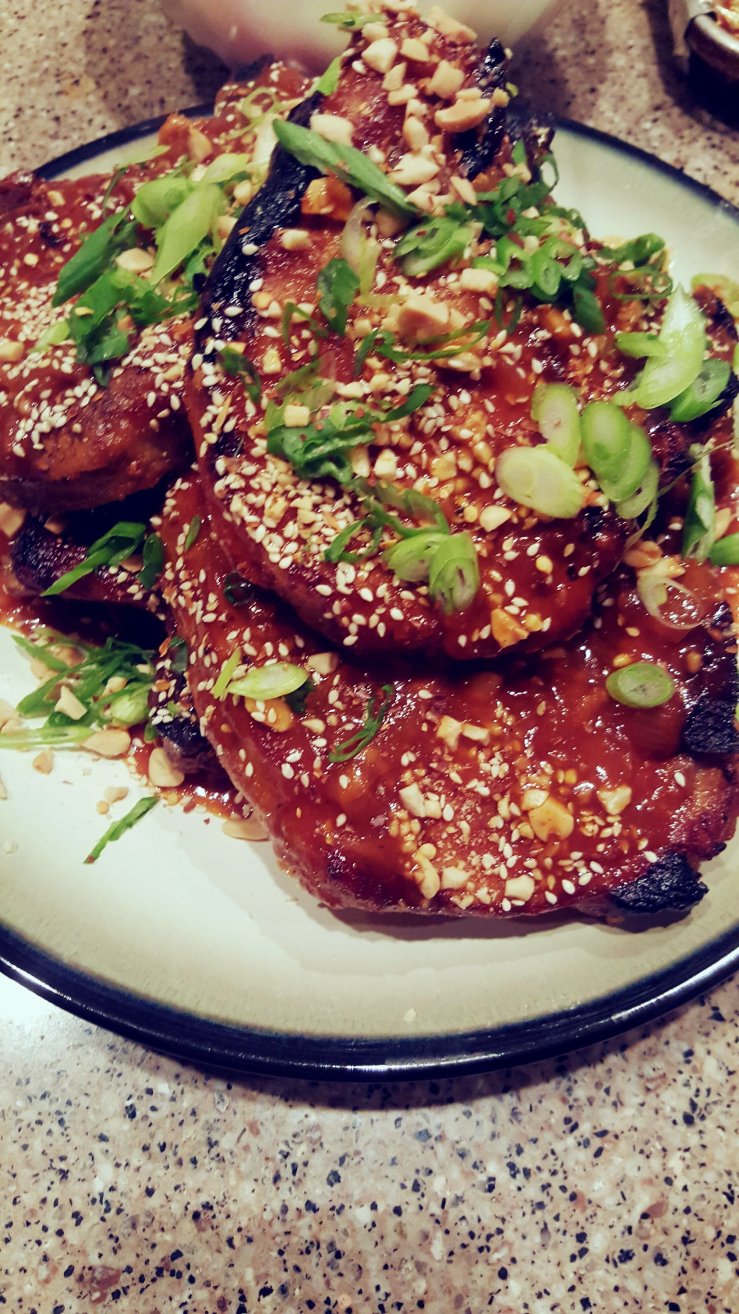 Gochujang Miso Pork chops are a medley of sweet, sour, spicy and salty. A perfect dish for a Sunday dinner to impress. This is a quick and easy recipe that does not require very much knife work. Your taste buds will be doing all the work!
Yields: 8 servings Prep Time: 10 Min. Cook Time: 15-20 Min.
INGREDIENTS:
- 8 Pork Loin Chops
- 3/4 C. Gochujang Paste
- 2 TB. White Miso Paste
- 1/4 C. Rice Wine Vinegar
- 1 1/2 C. Brown Sugar
- 1/4 C. Dark Soy Sauce
- .5 Ginger (nob), finely chopped
- 2 TB. Garlic, finely chopped
- 1 Lg. Onion, small dice
- 1 Bunch Scallions, Finely sliced on diagonal
- 1/2 C. Sesame Seeds, Toasted
- 1/2 C. Peanuts and Cashews, Toasted/Chopped (do not chop nuts finely, you still want good texture and not just dust on furniture)
- 1/4 C. Sesame Oil
- 2 TB. Sriracha
- 1/4 C. Red Chili Flakes
- 1/4 C. H20
- Cornstarch
- 2 TB. Black Pepper
- 1/4 C. Fish sauce
DIRECTIONS
- Marinade Pork Chops in mixture- Gochujang, Miso, Rice Wine Vinegar, Brown Sugar, Soy Sauce, Ginger, Onion, Garlic, Sriracha, Sesame Oil, Red Chili Flakes, Black Pepper, Fish sauce. Place in cooler, let marinade for at least 30 minutes to 1 hour.
- Preheat oven to 375 degrees. Place marinated pork chops on lined oiled sheet pan (before placing pork chops on sheet tray, make sure to shake off excess marinade).
- Place sheet tray in oven and cook until internal temperature of pork chop reaches 145 degrees, about 15-20 min. (depending on cut of chop)
- Place remaining marinade in a sauce pot and reduce by half, once pork is cooked add remaining liquid from sheet trays into sauce and simmer. Add 2.5 TB of Cornstarch and H20 slurry. Simmer to desired thickness.
- Toast sesame seeds and nuts separately in dry skillet over medium heat,set aside for garnish.
- Brush thickened sauce on pork chops and place under broiler for 5-7 minutes, until you established a good crusty char.
- Let pork chops rest for 5-7 minutes.
- Garnish with Sesame seeds, toasted nuts, red pepper flakes and scallions.
Revolving through cookbooks.
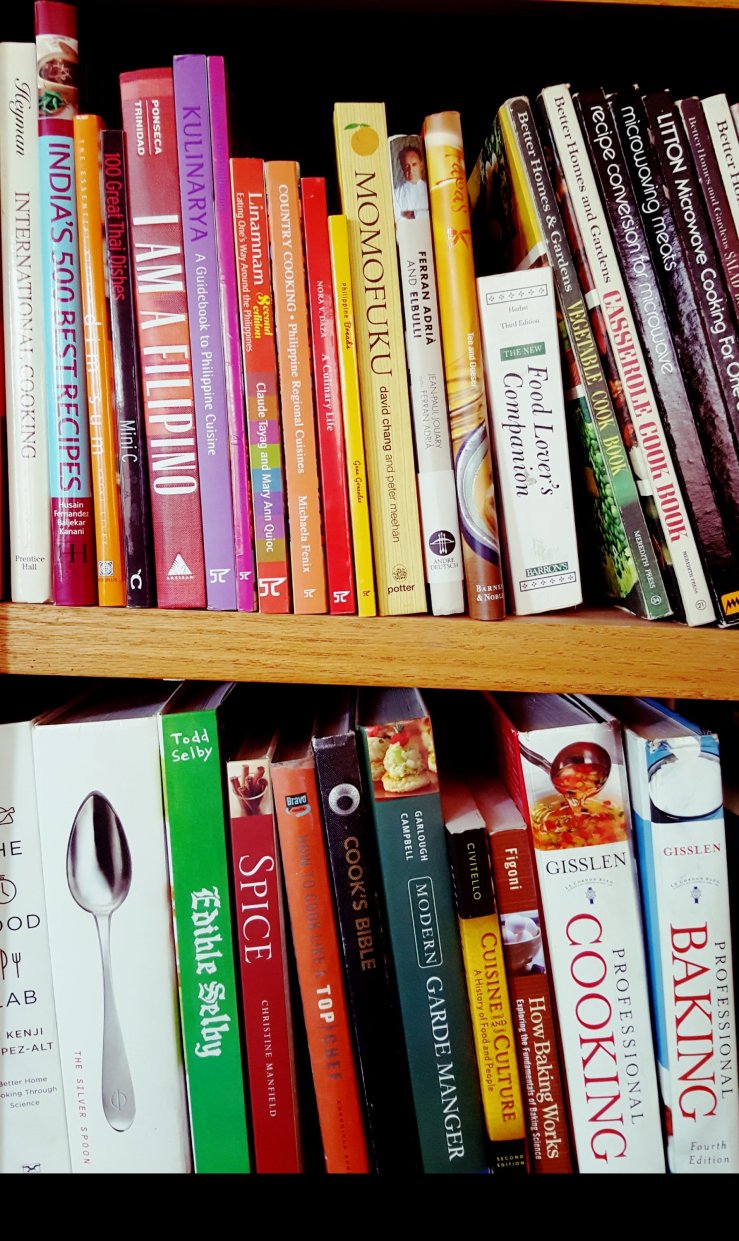
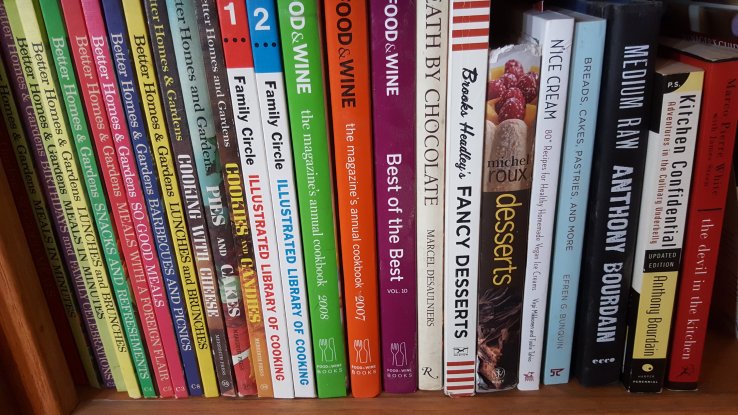
Cookbooks are a reflection of the inner cook. There are never enough cookbooks that you can accumulate and truly be satisfied. It is an ever-evolving digest. Cookbooks are the only thing that you can always revisit casually without fully reading it, and still be engaged. There is always a recipe that you haven’t tried, and inspires you to try something new.
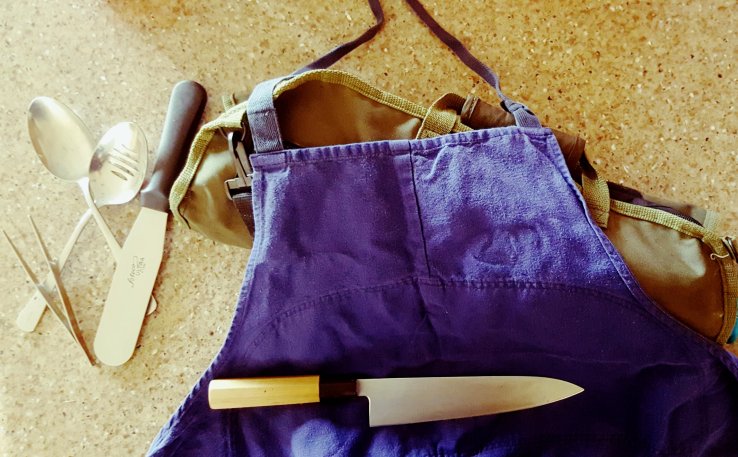
The confluence of home cook and professional cook can be merged. What makes a cook a great cook? It is not about seniority, it is about the eagerness to always learn something new, by gaining knowledge in the craft.
Cooking in a professional kitchen is a way to have a true experience on what it takes to be a professional cook/chef. You realize the speed, proficiency, and the literal blood and sweat of the kitchen. You learn a sense of urgency that you will instill in your everyday life. You learn things that cookbooks cannot give you; a reality check.
“You don’t need a silver fork to eat good food.” – Paul Prudhomme
“Big Dim sum in Little Chinatown”
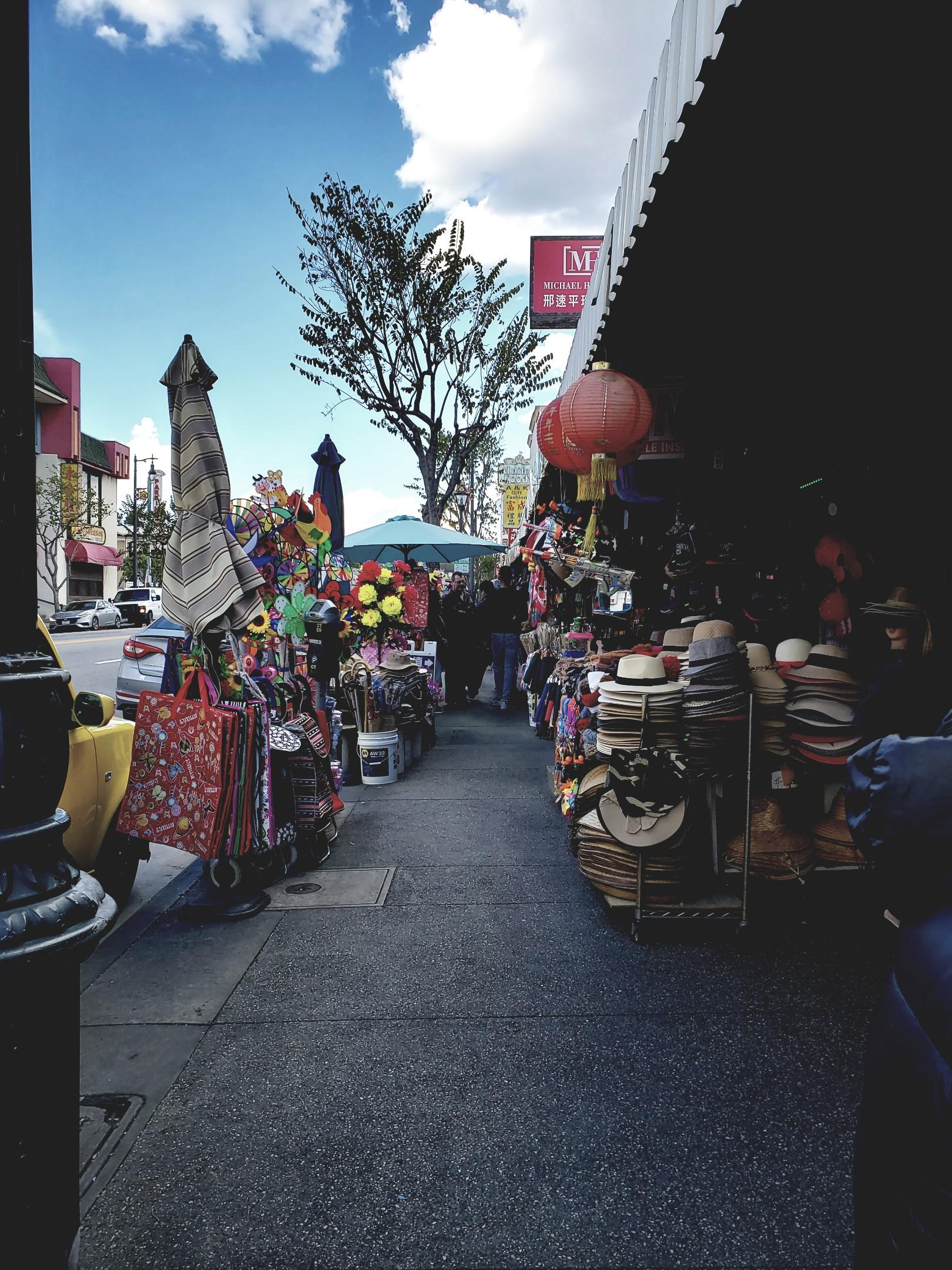

Chinatown, the epicenter of all that is Chinese, authentic at its finest, yet westernized to the unknown. It is a place where many find heritage, and others a place they call home. Walking through Los Angeles’ Chinatown near the end of February is a place that you can still find soulful warmth in a rather chilly climate. The place where you know there will be a budding feast for the eyes and mouth. A place where you can insatiably express your inner glutton for the sake of trying some wonderful Chinese food, made from people that’s storefront/ restaurant has been a generational namesake for years and years to come.
Of course there are new restaurants popping up here and there, the creme de la creme ; from David Chang (Majardomo) to Eddie Huang (BaoHaus), to the famous hot chicken from “Howlin’ Ray’s”, to the Goliath of cheeseburgers from “Burgerlords”. But all in all, you want to visit places that were the pioneers of Chinatown, the places that made it quintessentially Chinatown. We visited a lavishly-traditional Dim Sum restaurant, “Ocean Seafood”, found on the second floor of a building that other counterparts were as busy or even busier; where “slow-seasons” seem nonexistent. At the restaurant, you couldn’t control your appetite, you just wanted everything, all at once. As with most dim-sum restaurants. But there is something unique to Dim sum in Chinatown, and California Asian cuisine, there is a taste of soul, that is hard to duplicate unless you’ve been learning the craft from past generations, the O.G.’s. The dim sum carts came out fast, still hot, delicious and consistent.
Dim Sum to me is familial, nostalgic, and just feels like home. Since I was little, my family would always have Dim Sum every Sunday, it was something my sister and I looked forward to. In the early 90’s we would go to a once known restaurant filled with old school red leather booths, and a separate part of the restaurant filled with old and young men smoking cigarettes, reading a daily paper, maybe drinking some tea or scotch, while casually feasting on an array of Dim Sum. That area we were accustomed to, because when you were late, you were usually seated in the smoking area. The smell of steamed dumplings, sweet Char Sui pork buns, chicken feet, and lotus leaf wrapped sticky rice, would just permeate the room. The smell of lit cigarettes would just dissipate, but added character to the restaurants ambiance.
Taking a weekend trip to California just to have some delicious, authentic, Chinese food is what I call home, and tradition in my family. Traveling for me is a way to get away from the routine of life, eat great food, discover the new, and cherish life and the people I’ve shared it with. Enjoy your life. Don’t take yourself too seriously. Savor the moment.
LUMPIA + SHANGHAI SPRINGROLLS.
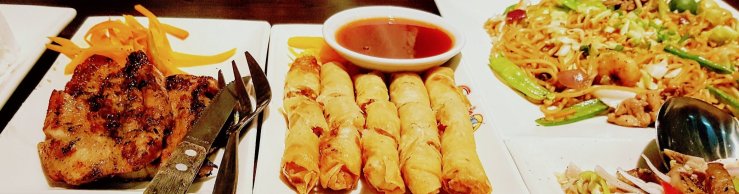
When someone discovers you are Filipino, typically the conversation moves to food — and the popular favorite is almost always Adobo, a dish composed of chicken or pork slowly braised in a soy/vinegar/calamansi/oyster sauce/peppercorn/bay leaf/chili sauce, which has a great balance of salt,fat, and acid all of which make a dish great. Another dish that strikes familiarity is Lumpia [loom-pia], a delectable fried crepe spring roll, that can please any palate. After-all, who doesn’t love fried food?
Lumpia, a classic spring roll, although the most typical Filipino dish, it is also, the most underrated. Growing up, I didn’t really know what a Shanghai roll was, I didn’t even know it was even really significant. The Lumpia I knew, was one that was filled with pork, shrimp, sweet potato (Kamote), green beans, bean sprouts, fish sauce, and a dash of the infamous ‘Magic-Sarap’. Which would only be served with a vinegar and garlic condiment.
Every Filipino household has their own interpretation of a good Lumpia, all which have gained their own respect.
Shanghai Rolls, another spring roll, consists of minced meat, usually ground pork and shrimp or corned beef, that are wrapped tightly to form a mini delectable one-biter, usually accompanied with a sweet chili sauce, these rolls are often found in Filipino “Turo-Turo” restaurants, because not only are they delicious and convenient, but cost effective as well. Filipino, “Turo-Turo” restaurants are hidden gems that serve a plethora of native dishes, inspired by native street food.
I guess the point of this insight, is what makes a “Lumpia” Filipino? It is also an ode to the delicious crispy Filipino delight, that is not only a conversation starter, but is as familiar as the good ol’ hamburger, which are both in their own right, classic.
The Journey Begins
Welcome to a place where thoughts are shared about gastronomy, filipino cuisine, recipes, and culture. http://changeoftaste.food.blog
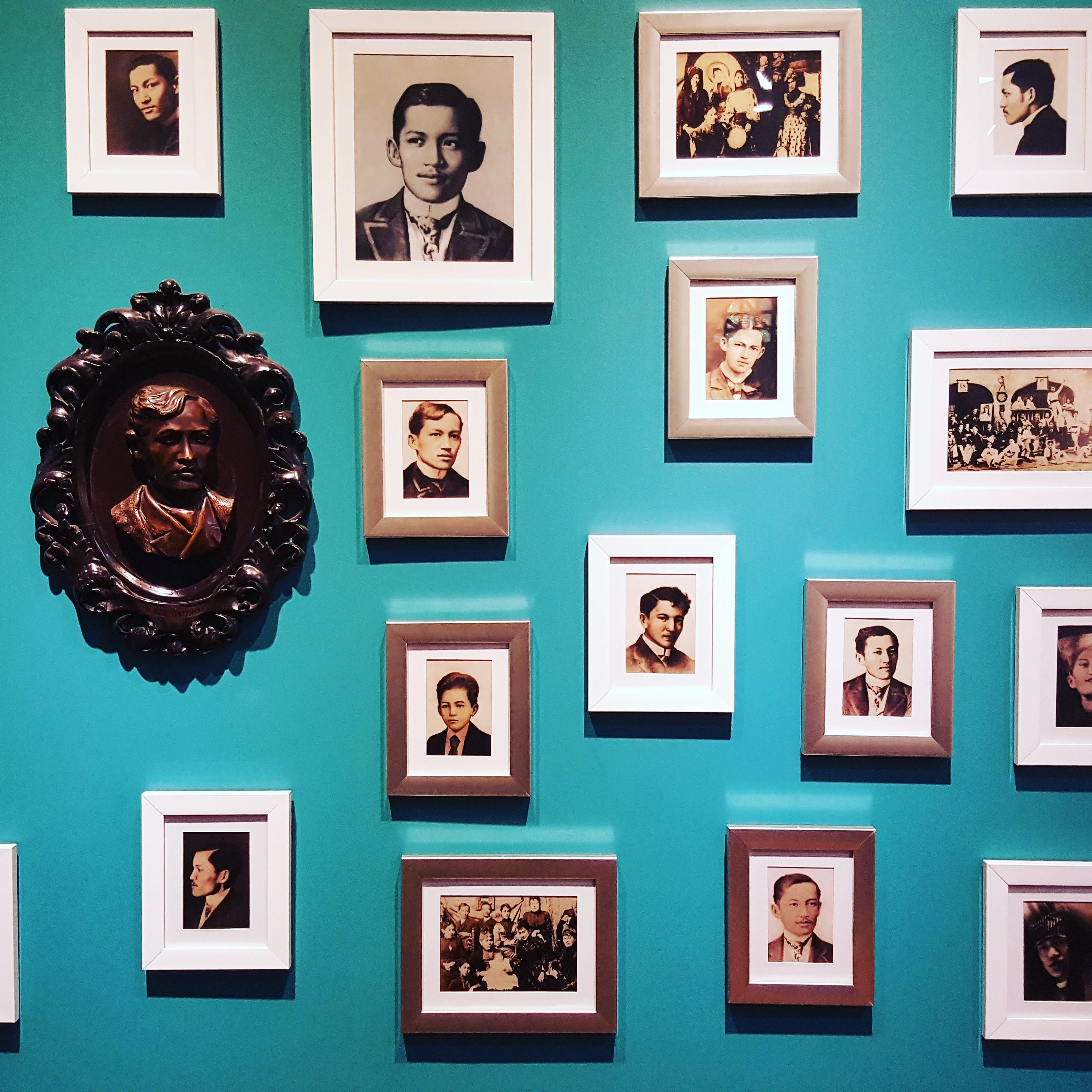
“You must know where you’re from in order to get where you’re going.” – Jose Rizal

